
Standing outside after a Carolina thunderstorm, you might notice water pooling around your foundation or trickling down your siding. These signs point to clogged gutters, a hidden threat that can quickly lead to costly repairs. In Charlotte, where heavy rain and humidity are common, understanding how gutters protect your home’s structure and why regular cleaning matters helps you safeguard your property from mold, wood rot, and foundation damage. Discover expert preventative tips and the real reasons gutter maintenance should be a top priority for every homeowner.
Table of Contents
- What Gutter Cleaning Involves And Common Myths
- Types Of Damage Caused By Clogged Gutters
- How Gutters Protect Your Home’s Structure
- Signs Of Gutter Problems In North Carolina
- Financial Risks And Costly Repairs To Avoid
Key Takeaways
| Point | Details |
|---|---|
| Gutter Maintenance is Essential | Regular gutter cleaning prevents water damage to roofs, foundations, and homes, especially in regions with heavy rainfall and humidity like Charlotte. |
| Misconceptions About Gutters | Many homeowners mistakenly believe gutters are merely decorative; however, they play a critical role in protecting structures from water damage. |
| Cost of Neglecting Gutters | Ignoring gutter maintenance can lead to significant repair costs, far exceeding the relatively low expense of regular cleaning. |
| Signs of Gutter Issues | Homeowners should watch for signs like water overflow and standing water in gutters, as these indicate blockages or improper installation that require immediate attention. |
What Gutter Cleaning Involves and Common Myths
Gutter cleaning is far more than just removing leaves from a channel. When you clean your Charlotte home’s gutters, you’re performing essential maintenance that keeps water flowing exactly where it needs to go, away from your roof, walls, and foundation. The process involves several key steps. First, you’ll remove debris like leaves, twigs, and dirt that accumulates in the channels. Next comes flushing the gutters with water to clear any remaining sediment and ensure the system is flowing properly. Finally, you’ll check downspouts to confirm water is reaching ground level without obstruction. Many homeowners don’t realize that gutter maintenance supports roof longevity by preventing water backup that can damage shingles and underlying structures.
The most persistent myth about gutters is that they’re primarily decorative additions to your home. This couldn’t be further from the truth. Gutters serve a critical protective function. Without them, rainwater flows directly down your building’s exterior, saturating soil around your foundation, infiltrating basements, and creating conditions for moisture damage. In Charlotte’s humid climate with frequent thunderstorms, this becomes especially problematic. The water cascading down your walls causes dampness that leads to mold growth, wood rot in fascia and trim, and structural deterioration over time. Another common myth suggests that all gutters are the same. While gutters come in multiple materials—aluminum, copper, vinyl, and steel—and two primary styles, K-style and U-style, they all perform the same fundamental function: directing water away from your home. The difference is mainly aesthetic and related to durability. K-style gutters look more decorative and blend with most homes, while U-style gutters offer a more utilitarian appearance but handle water volume equally well.
Some homeowners believe they don’t need to clean gutters if they’re relatively new or if their yard doesn’t have many trees. This is a dangerous assumption. Even homes surrounded by minimal vegetation will accumulate granules from aging shingles, roof debris, pollen, and dust that create blockages over time. In Charlotte’s four distinct seasons, spring pollen and summer thunderstorms create their own debris challenges. When gutters become clogged, water can’t flow properly, causing it to back up beneath your roof’s edge, seep into your attic, or overflow onto your foundation. Professional gutter cleaning typically involves inspection for damage like rust, separations at seams, or improper slope that prevents proper drainage. This is why home inspectors are required to evaluate gutters and downspouts as part of comprehensive home inspections. The real benefit comes from catching these issues before they become expensive repairs. Your gutters might look fine from the ground, but sagging sections or hidden damage can develop quickly when water sits instead of flowing freely.
Pro tip: Schedule gutter cleaning twice yearly in Charlotte, once before fall leaf drop in September and again in late spring after pollen season, to prevent buildup during our heaviest rain months.
Here’s a quick guide to gutter materials and their characteristics:
| Gutter Material | Durability | Appearance | Typical Lifespan |
|---|---|---|---|
| Aluminum | Rust-resistant, lightweight | Versatile, blends with most homes | 20+ years |
| Copper | Extremely durable, weatherproof | Distinctive patina develops | 50+ years |
| Vinyl | Lightweight, lower strength | Simple, utilitarian look | 10-20 years |
| Steel | Strong but can rust | Industrial, robust style | 15-25 years |
Types of Damage Caused by Clogged Gutters
Clogged gutters don’t just sit there collecting leaves. They actively work against your home, creating a domino effect of damage that spreads from your roof all the way down to your foundation. When gutters become blocked, water has nowhere to go except over the edges and down the sides of your house. This overflow immediately damages your roof by causing water to back up beneath the shingles, leading to rot and leaks that can take months or even years to discover. Once water gets under your roof deck, it saturates the wood framing and insulation, creating the perfect environment for mold growth and structural deterioration. Charlotte homes are especially vulnerable during our heavy spring and summer storms when a single clogged gutter can channel gallons of water directly onto your roof’s edge. The fascia boards that hold your gutters in place also suffer tremendously. These wooden boards are constantly exposed to the water pooling in your gutters, and the moisture causes them to rot from the inside out. When fascia boards weaken, your entire gutter system becomes unstable, eventually sagging or pulling away from your house.
Beyond roof damage, clogged gutters create serious problems at ground level. When water overflows instead of flowing through downspouts to the ground, it saturates the soil around your foundation. This constant moisture seepage causes foundation cracks as the soil expands and contracts, and water infiltrates your basement or crawlspace, leading to moisture buildup that compromises indoor air quality. Mold thrives in these damp environments and spreads quickly, creating health hazards for your family and expensive remediation costs. The damage extends to everything near your foundation: patios develop cracks and heave, doors and windows rot at the frame, and landscaping becomes waterlogged and dies. Your siding also suffers from constant water cascading down it, causing rot, discoloration, and weakened material that no longer protects your home’s interior walls.
One often overlooked consequence of clogged gutters is the long-term structural damage that accumulates quietly. Roof damage from water backup can compromise framing that you can’t see until it’s too late. By the time you notice water stains on your ceiling, significant damage has already occurred in the attic space above. Foundation damage also tends to hide until it becomes catastrophic. A small crack from foundation settling due to gutter overflow can expand over years until you’re looking at tens of thousands of dollars in foundation repair. In Charlotte’s climate with our wet springs and occasional heavy rains, this risk is very real. The cost of repairing water damage, replacing rotted wood, treating mold, and fixing foundation issues dwarfs the minimal investment of regular gutter maintenance. What starts as clogged gutters becomes water damage inside your walls, structural repairs to your roof and foundation, and potential health problems from mold exposure.
Pro tip: Install gutter guards or screens in addition to regular cleaning to reduce debris accumulation and protect your gutters during Charlotte’s heavy pollen and leaf seasons, extending the time between professional cleanings.
How Gutters Protect Your Home’s Structure
Your gutters are essentially a water management system for your entire home. Think of them as the first line of defense against one of the most destructive forces in homeownership: water infiltration. When rain falls on your roof, it has to go somewhere, and without gutters, that water runs straight down your walls and saturates the ground around your foundation. With properly functioning gutters, rainwater is channeled away from your home in a controlled manner, protecting every major structural element from your roof to your basement. The protection starts at the top. Gutters prevent water from pooling at the roof’s edge, which would seep under shingles and cause rot in the decking and framing. But the real value becomes apparent when you consider the foundation. Gutters channel roof water away from foundations, preventing the soil saturation that causes foundation cracks, settling, and basement flooding. In Charlotte’s clay-heavy soil and humid climate, this protection is invaluable. The soil around your foundation expands and contracts with moisture, and excess water from roof runoff accelerates this process, causing stress on your foundation walls.

What many Charlotte homeowners don’t realize is just how much water flows off a roof during a typical rainstorm. A 2,000 square foot roof can shed over 1,000 gallons of water per inch of rainfall. That’s an enormous volume of water that needs somewhere to go. Without gutters, all that water hits the ground immediately adjacent to your foundation, creating hydrostatic pressure against your basement walls. Mold and mildew thrive in the moisture-rich basement environment that results, compromising indoor air quality and creating health hazards. Wooden elements like your sill plates, floor joists, and even wall studs begin to rot from the inside out. Proper roof drainage systems prevent basement flooding and structural damage that would cost tens of thousands of dollars to repair. Your gutters also protect your home’s exterior. Siding, trim, fascia, and corner boards are all vulnerable to water damage when gutters aren’t functioning. Water that cascades down your walls causes wood to rot, paint to peel, and siding to deteriorate prematurely. In Charlotte’s humid summers, this deterioration accelerates dramatically. Your gutters also protect landscaping investment and prevent erosion around your foundation. The standing water that collects when gutters fail creates muddy, eroded areas that look unsightly and allow water to seep deeper into the soil around your foundation.
The key to understanding gutter protection is recognizing that it’s about managing volume and distance. Gutters must not only collect water but also direct it safely away from your home. Building codes require that water be directed at least 5 feet away from your foundation, or connected to proper drainage systems that carry water away safely. A gutter system that collects water but empties it directly at your foundation is almost worthless. This is why downspouts and extensions are just as critical as the gutters themselves. In Charlotte, where we experience heavy spring thunderstorms and occasional tropical systems, having a complete gutter and drainage system is essential. A properly maintained gutter system working in combination with clear downspouts, extensions, and grading protects against water infiltration, mold growth, foundation damage, and structural deterioration. The investment in gutter cleaning and maintenance is minimal compared to the cost of repairing water damage, treating mold, replacing rotted wood, or fixing foundation issues. When your gutters are clean and functioning properly, water flows predictably and safely away from your home, preserving your structure for decades to come.
Pro tip: Have downspout extensions installed or extended to discharge water at least 5 to 7 feet from your foundation, and verify they’re clear and flowing after every storm to ensure your gutters are providing maximum protection.
Signs of Gutter Problems in North Carolina
Gutter problems rarely announce themselves loudly. Instead, they show up as subtle warning signs that most Charlotte homeowners miss until significant damage has already occurred. The first and most obvious sign is water overflowing from your gutters during a rainstorm. If you notice water cascading over the edges of your gutters instead of flowing through the downspouts, you have a blockage or a capacity issue. Standing water sitting in your gutters after the rain stops is another red flag. This indicates improper slope, which is critical because gutters need to tilt slightly toward the downspout to function properly. Water that pools in your gutters becomes heavy, stresses the fasteners, and creates an ideal breeding ground for mosquitoes and algae. Look closely at your gutters themselves for visible damage. Rust spots, especially on older metal gutters, signal corrosion that will eventually become holes and leaks. Cracks or small holes might seem minor, but they allow water to escape right onto your fascia boards below, causing rot that compromises the structural support of your entire gutter system. Sagging gutters are particularly concerning and often indicate that the fasteners are failing or the weight of debris and standing water has bent the system out of shape.
One of the most telling signs that your gutters need attention is what’s happening at ground level around your foundation. Water pooling around your home’s foundation suggests that either your gutters aren’t collecting water properly or your downspouts aren’t discharging it far enough away. In North Carolina’s heavy rainfall seasons, this water saturation creates serious foundation risks. Look for mud, erosion, or visible water stains on the soil immediately adjacent to your foundation after storms. Check your basement or crawlspace for moisture, musty odors, or visible mold growth. These are all signs that water from your roof is infiltrating around your foundation, likely due to gutter failure. Damage to your fascia and soffit boards is another indicator of gutter problems. The fascia board sits directly behind and below your gutters and bears the weight of the entire gutter system. When gutters are clogged or overflowing, water constantly drips down onto the fascia, causing it to rot and weaken. You might notice paint peeling, wood that looks soft or spongy, or visible rot along these boards. Similarly, inspect your downspouts to ensure they’re intact and securely fastened. Downspouts that are cracked, separated, or missing sections won’t effectively carry water away from your foundation, even if your gutters are clean.
Interior signs of gutter problems can be equally important as exterior signs. Water stains on your ceiling, especially in the attic area, indicate that water is backing up under your roof or seeping through gaps where gutters have failed to properly channel water. Mold growth in your attic is a serious sign that moisture is infiltrating from above, often due to clogged gutters causing water to back up onto your roof. Check your attic after heavy rains to look for wet insulation, water dripping from rafters, or that telltale musty smell. Peeling paint on your exterior siding or trim, particularly on the side of your home that receives the most rain, often results from water cascading down your walls when gutters aren’t functioning. The combination of water damage and North Carolina’s humid climate creates perfect conditions for wood rot and mold. If you’re seeing any of these signs, it’s time to take action. Many of these issues start small but escalate quickly in our state’s wet climate. The good news is that catching roof damage early through inspection and addressing gutter problems promptly can prevent expensive repairs down the road.
Pro tip: After heavy rainstorms, walk around your home’s exterior and look for water stains on the soil, overflow patterns in your gutters, and any water entering your foundation area, which are the three most reliable indicators that your gutter system needs professional attention immediately.
Financial Risks and Costly Repairs to Avoid
Neglecting your gutters isn’t just a maintenance issue. It’s a financial decision with serious consequences. Many Charlotte homeowners don’t realize that the small cost of gutter cleaning every six months pales in comparison to the repair bills they’ll face if they ignore the problem. Foundation repair alone can run $25,000 to $100,000 or more, depending on the extent of damage. Roof replacement typically costs $15,000 to $30,000 for an average Charlotte home. Water damage remediation, including mold treatment and structural repairs, frequently exceeds $10,000. When you add these potential costs together, regular gutter maintenance becomes one of the most cost-effective investments you can make as a homeowner. The financial risks begin the moment your gutters stop functioning properly. Water that should flow safely away from your home instead creates a perfect storm of damage. Structural damage from water infiltration compounds over time, meaning early small problems become exponentially more expensive later. A rotted fascia board that costs $500 to fix today might necessitate gutter replacement and foundation repair costing $15,000 if ignored for a few years.
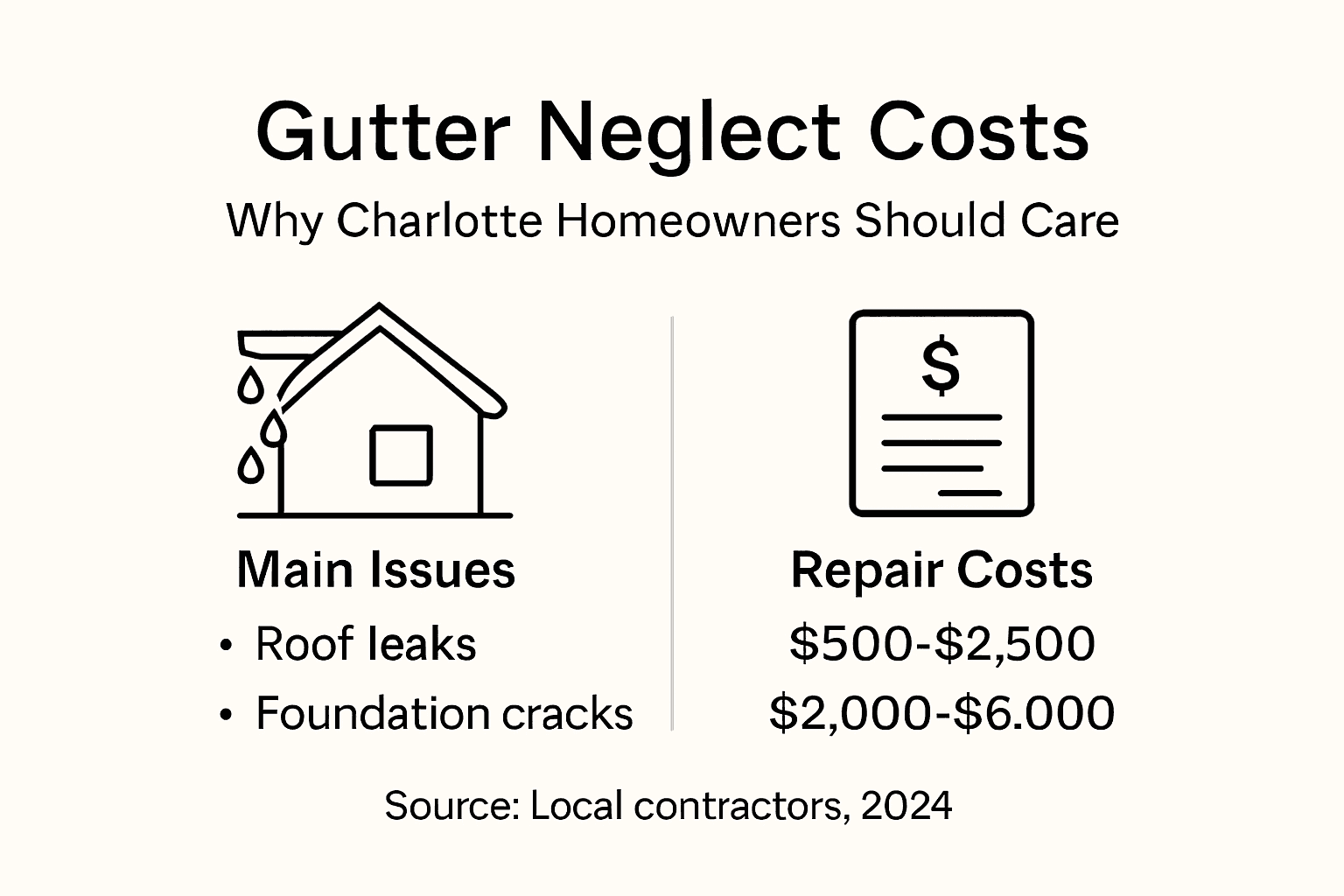
One critical financial consideration that many homeowners overlook is insurance coverage. Homeowners insurance often excludes gutter damage caused by neglect, meaning you’ll pay out of pocket for repairs resulting from clogged or poorly maintained gutters. Your insurance policy may cover damage from a fallen tree crushing your gutters, but it typically won’t cover damage from years of debris accumulation and water overflow. This means that a foundation crack caused by water infiltration from clogged gutters could be your responsibility entirely, not your insurer’s. Additionally, unprepared homes with foundation damage or water infiltration issues face reduced resale value. Potential buyers conduct inspections that reveal water damage, mold, and structural issues, leading them to demand price reductions or walk away from the deal entirely. In Charlotte’s competitive real estate market, a home with known water damage problems loses significant value. Real estate experts estimate that foundation damage can reduce a home’s value by 15 to 25 percent. Water damage and mold issues reduce value even more when buyers discover them during inspections.
The cascade of financial consequences extends beyond repairs to your home’s systems. Your HVAC system can suffer significant damage from moisture infiltration, potentially requiring a $5,000 to $12,000 replacement. Electrical systems compromised by water damage create fire hazards that insurance won’t cover if caused by negligent maintenance. Attic insulation saturated by water loses its effectiveness, increasing your heating and cooling costs year-round. A single season of water damage from clogged gutters might increase your energy bills by 20 to 30 percent permanently if the insulation isn’t replaced. Mold remediation is expensive and can cost anywhere from $2,000 for minor treatment to $25,000 or more for extensive infestations. Even after mold is professionally remediated, health issues and lingering property damage drive up costs further. The health impacts of mold exposure include respiratory problems, allergies, and asthma exacerbation, leading to medical expenses that have nothing to do with home repair but everything to do with your home’s condition.
The most important financial reality is this: preventive maintenance is exponentially cheaper than reactive repair. A professional gutter cleaning costs $150 to $300 per service. Most Charlotte homes benefit from cleaning twice yearly, totaling $300 to $600 annually. Over ten years, that’s only $3,000 to $6,000 spent on prevention. Compare that to a single foundation repair project costing $40,000, and the math is undeniable. Gutter guards or screens add another $500 to $1,500 as a one-time investment but can extend the time between cleanings significantly. The financial risks of neglecting gutters aren’t theoretical. They’re specific, quantifiable, and very real for Charlotte homeowners. When you consider that cheap repairs often cost more long-term than quality maintenance, the logic of proper gutter care becomes irrefutable. Your future self will thank you for the small investment in prevention today.
Below is a summary of repair costs versus regular gutter maintenance:
| Issue | Typical Repair Cost | Preventive Cost (per year) | Financial Impact |
|---|---|---|---|
| Foundation Repair | $25,000 – $100,000 | $300 – $600 | Extremely High |
| Roof Replacement | $15,000 – $30,000 | $300 – $600 | Significant |
| Mold Remediation | $2,000 – $25,000 | $300 – $600 | Expensive |
| Gutter Cleaning | $0 (if neglected) | $300 – $600 | Cost-effective |
Pro tip: Document your gutter maintenance with photos and receipts to demonstrate regular upkeep to potential buyers or insurance adjusters, as proof of maintenance protects both your property value and your ability to file claims for storm-related damage.
Protect Your Charlotte Home with Expert Roof and Gutter Care
Clogged gutters create a chain reaction of damage that threatens your roof, foundation, and overall home integrity. The risks include costly repairs from water infiltration, mold growth, and structural rot. At Liberty Roofworks, we understand how vital it is to maintain clean gutters to ensure your roofing system performs perfectly through every storm and season. Your gutters are the first line of defense, and they must work flawlessly to protect your investment.
Partner with the trusted Charlotte roofing experts who go beyond roof repairs and replacements. From addressing storm damage to performing thorough inspections that catch hidden water issues, our team helps you avoid the severe consequences of neglected gutters. Let us help you maintain a safe, dry, and valuable home. Don’t wait until minor gutter problems turn into major roofing and foundation repairs. Visit Liberty Roofworks today to learn about our comprehensive Residential Roof Repair & Replacements services and storm damage solutions. Protect your home now by scheduling a professional roofing consultation with us.
Frequently Asked Questions
Why is gutter cleaning important for my home?
Gutter cleaning is essential because it prevents water from backing up, which can lead to roof damage, mold growth, and foundation issues. By ensuring that water flows away from your home, you protect its structural integrity and longevity.
How often should I clean my gutters?
It’s recommended to clean your gutters twice a year, ideally before fall leaf drop and after pollen season in late spring, to prevent blockages during heavy rain months.
What are the signs that my gutters need cleaning?
Signs that your gutters need cleaning include water overflowing from the edges during rain, standing water in the gutters after storms, and visible debris buildup. Additionally, check for water pooling around your foundation or in your basement.
What types of damage can clogged gutters cause?
Clogged gutters can lead to roof leaks, rotting fascia boards, foundation cracks, and mold growth inside your home. Ultimately, neglecting gutter cleaning can result in expensive repairs and decreased property value.