Most American homeowners in Charlotte face stricter roofing requirements in 2025, with updated codes increasing wind resistance standards by up to 15 percent for residential replacements. This matters because a non-compliant roof risks costly delays and safety hazards during severe weather. Discover how the latest building code changes for Charlotte and North Carolina impact your choice of materials, installation methods, and permit approvals—helping you avoid common pitfalls and guarantee a safe, compliant renovation.
Table of Contents
- Defining Roofing Code Requirements For 2025
- Key Roofing Material And Installation Standards
- Permit Process And Inspection Updates
- Wind Resistance And Weather-Specific Provisions
- Compliance Risks And Common Homeowner Mistakes
Key Takeaways
| Point | Details |
|---|---|
| Updated Code Requirements | The 2025 roofing code mandates enhanced wind resistance, energy efficiency, and fire resistance standards for residential roofs in Charlotte and North Carolina. |
| Material and Installation Standards | Homeowners must ensure that roofing materials meet specific performance criteria and installation practices are adhered to under the new regulations. |
| Permit and Inspection Process | Stricter documentation and inspection requirements are now in place for roofing projects, necessitating comprehensive compliance from homeowners. |
| Avoiding Compliance Risks | Homeowners should maintain thorough documentation and work with licensed professionals to avoid delays and legal penalties associated with roofing code compliance. |
Defining Roofing Code Requirements for 2025
Roofing code requirements are comprehensive guidelines that establish minimum performance standards for residential roof installations in Charlotte and across North Carolina. Building codes from the International Code Council (ICC) serve as the critical framework determining how roofs must be designed, constructed, and maintained to ensure public safety and structural integrity.
The 2025 roofing code requirements represent a significant evolution in building standards, focusing on three primary dimensions: structural performance, energy efficiency, and environmental resilience. Wind resistance emerges as a paramount concern for Charlotte homeowners, with updated regulations mandating stricter attachment protocols for roof systems to withstand potential severe weather events. Comprehensive wind resistance standards now require enhanced fastening techniques and materials that can endure higher wind speed thresholds.
Key components of the 2025 roofing codes include specific requirements around material selection, installation practices, and performance testing. Homeowners must now ensure their roof assemblies meet enhanced thermal performance metrics, incorporate improved moisture barrier technologies, and demonstrate compliance with more rigorous fire resistance classifications. Local building departments in Charlotte will be conducting more stringent inspections to verify that roof installations meet these updated performance standards.
Here is a summary of key changes in the 2025 roofing code requirements compared to prior standards:
| Code Requirement Area | 2025 Standards Highlights | Previous Approach |
|---|---|---|
| Wind Resistance | Enhanced fastening, higher wind zones | Basic fastener specs |
| Energy Efficiency | Stricter thermal performance metrics | Minimal insulation requirements |
| Fire Resistance | Upgraded classification and testing | Standard material ratings |
| Material Certification | Rigorous impact & uplift documentation | General manufacturer documents |
| Inspection Rigor | Multiple checkpoints, documentation | Fewer, less detailed inspections |
Pro tip: Before starting any roof replacement project, request a detailed code compliance review from a licensed roofing professional to understand the specific requirements affecting your home’s unique architectural characteristics.
Key Roofing Material and Installation Standards
The 2025 roofing code requirements introduce stringent guidelines for material selection and installation practices that Charlotte homeowners must carefully navigate. Comprehensive roofing material standards now mandate specific performance criteria for roof assemblies, emphasizing durability, weather resistance, and long-term structural integrity.
Approved roofing materials for residential applications in North Carolina must meet enhanced testing protocols. Asphalt shingles, metal roofing, and tile systems now require more rigorous certification, including impact resistance ratings and wind uplift performance documentation. Homeowners must verify that their chosen materials comply with updated building codes, which now include more comprehensive requirements for fire resistance, thermal performance, and environmental sustainability.

Installation standards have become significantly more detailed, with specific guidelines for fastener placement, underlayment preparation, and moisture barrier implementation. The new regulations mandate precise attachment techniques, minimum sheathing thickness, and ventilation requirements that directly impact the roof’s overall performance and longevity. Local building inspectors in Charlotte will conduct more thorough examinations to ensure complete compliance with these enhanced installation protocols.
Pro tip: Always request a detailed material compliance certification from your roofing contractor, confirming that all proposed materials and installation methods meet the 2025 North Carolina building code requirements.
Permit Process and Inspection Updates
The 2025 roofing code requirements in Charlotte have significantly transformed the permit and inspection landscape for residential roofing projects. Mecklenburg County’s updated permitting guidelines now mandate more comprehensive documentation and stricter compliance protocols for homeowners undertaking roof replacements or substantial repairs.
Permit requirements have become more nuanced, distinguishing between minor repairs and full roof replacements. Homeowners must now obtain specific permits for projects involving structural modifications, complete roof system replacements, or significant material upgrades. The new regulations classify roofing projects into distinct categories, each with its own documentation and inspection requirements. Critical documentation now includes detailed material specifications, installation method descriptions, and comprehensive performance documentation that demonstrates compliance with updated building standards.
Inspection protocols have evolved to ensure more rigorous verification of roofing work. Local building inspectors in Charlotte will conduct multiple checkpoint inspections throughout the roofing project, examining everything from initial material preparation to final installation techniques. These inspections will focus on verifying compliance with wind resistance standards, proper fastening techniques, moisture barrier integrity, and overall structural performance. Contractors must now schedule precise inspection windows and provide advanced documentation demonstrating their adherence to the 2025 building code requirements.
Pro tip: Before starting your roofing project, contact the Mecklenburg County Permit Office to confirm the exact documentation and inspection requirements specific to your proposed roof replacement or repair.
Wind Resistance and Weather-Specific Provisions
Charlotte homeowners face increasingly stringent wind resistance requirements designed to protect residential structures from severe weather challenges. North Carolina’s updated wind load regulations establish comprehensive guidelines that mandate specific engineering standards for roof installations, particularly in regions prone to high-wind events.
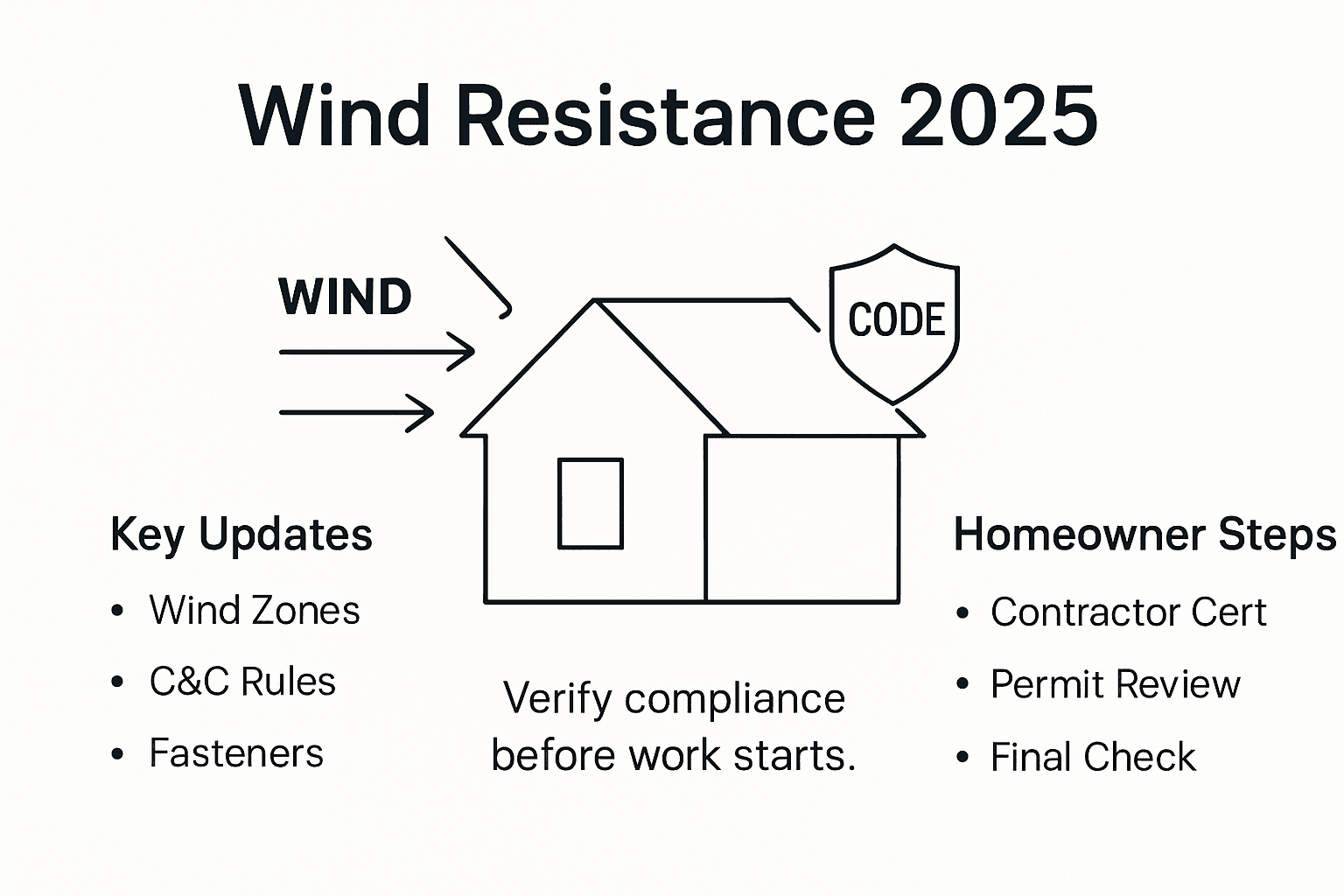
Wind speed zones now play a critical role in determining roof system requirements. For Charlotte, which falls within the 100-110 mph wind rating zone, homeowners must implement enhanced attachment methods and material selections. The new provisions require precise engineering specifications for roof components, including detailed requirements for fastener placement, sheathing thickness, and connection methods. Roofing systems must now demonstrate the ability to withstand significant uplift forces, with mandatory testing and documentation proving their structural integrity under extreme weather conditions.
The 2025 weather-specific provisions introduce more rigorous Components and Cladding (C&C) requirements that directly impact roof design and installation. These regulations focus on creating comprehensive wind resistance strategies, mandating specific attachment techniques that go beyond traditional installation methods. Contractors must now provide detailed documentation demonstrating how each roofing system will perform under extreme wind conditions, including precise calculations of wind uplift resistance and structural load-bearing capabilities. This approach ensures that residential roofs in Charlotte can effectively withstand the region’s challenging weather patterns.
Pro tip: Request a comprehensive wind resistance certification from your roofing contractor that specifically addresses the 2025 North Carolina wind load requirements for your specific location.
Compliance Risks and Common Homeowner Mistakes
Navigating the complex landscape of roofing code compliance presents significant challenges for Charlotte homeowners. Top roofing code compliance requirements reveal that approximately 20% of residential roofing projects encounter substantial delays or mandatory rework due to critical compliance oversights.
The most frequent compliance risks stem from inadequate permit documentation, using non-approved roofing materials, and failing to meet detailed installation specifications. Homeowners often underestimate the complexity of local building codes, mistakenly assuming that contractors will automatically ensure full compliance. Critical mistakes include attempting unpermitted roof modifications, neglecting required inspections, and selecting roofing materials that do not meet the 2025 performance standards. These errors can result in significant financial penalties, forced roof removal, or mandatory reconstruction at the homeowner’s expense.
Mecklenburg County’s stringent enforcement mechanisms mean that seemingly minor compliance infractions can lead to substantial legal and financial consequences. Roofing projects now require comprehensive documentation, including detailed material certifications, precise installation records, and energy efficiency performance data. Contractors must provide explicit evidence demonstrating that every aspect of the roof installation meets the intricate requirements outlined in the 2025 building codes. Homeowners who fail to maintain thorough documentation or who work with non-licensed professionals risk substantial fines and potential mandatory roof reconstruction.
The following table outlines common compliance pitfalls and ways to avoid them as a homeowner:
| Common Compliance Issue | Risk if Ignored | How to Avoid |
|---|---|---|
| Incomplete permit documentation | Project delays, possible fines | Ensure all forms are submitted |
| Non-compliant materials | Roof removal, safety risks | Require certified materials only |
| Skipping required inspections | Mandatory rework, legal issues | Schedule each inspection promptly |
| Working with unlicensed contractors | Legal penalties, poor work | Hire licensed, vetted professionals |
Pro tip: Maintain a comprehensive project file with all permits, material certifications, inspection reports, and contractor credentials to protect yourself from potential compliance disputes.
Stay Ahead of 2025 Roofing Code Requirements with Expert Guidance
The updated 2025 roofing code requirements bring new challenges for Charlotte homeowners. From enhanced wind resistance standards to stricter material certifications and rigorous inspection protocols, navigating these complex regulations on your own can be overwhelming. At Liberty Roofworks, we understand the critical importance of compliance and quality in every roofing project. Whether you face the need for a residential roof repair or a complete roof replacement, we make sure your home meets or exceeds these updated building codes while providing lasting protection.
Do not risk costly delays or compliance issues by choosing the wrong materials or contractors. Our experienced team specializes in Residential Roof Repair & Replacements and uses only certified materials that fulfill 2025 performance standards. With clear documentation, precise installation techniques, and thorough inspections, we deliver peace of mind alongside superior craftsmanship. Take proactive control of your roofing project today by visiting Liberty Roofworks for a detailed consultation and code compliance review. Ensure your Charlotte home is protected now and for years to come.
Frequently Asked Questions
What are the key changes in the 2025 roofing code requirements?
The 2025 roofing code requirements include enhanced standards for wind resistance, stricter energy efficiency metrics, upgraded fire resistance classifications, and more rigorous inspection protocols compared to previous standards.
How can homeowners ensure compliance with the 2025 roofing code?
Homeowners can ensure compliance by obtaining the correct permits, using approved materials, following the detailed installation standards, and scheduling inspections throughout the roofing project to meet the updated building codes.
What specific materials are required under the 2025 roofing code?
Approved materials must meet enhanced testing protocols for durability and performance. Common materials like asphalt shingles, metal roofing, and tile systems now require certifications for impact resistance, wind uplift performance, and fire resistance.
What are the consequences of non-compliance with roofing code requirements?
Consequences of non-compliance can include project delays, financial penalties, mandatory rework or roof removal, and legal issues. Homeowners risk significant costs if they do not adhere to the updated standards.
Recommended
-
- Understanding Roofing Trends in Charlotte: Insights for Homeowners – Liberty Roofworks
- Understanding Cool Roofing Standards 2025 for Homeowners – Liberty Roofworks
- Roofing Safety Requirements: Complete Guide for 2025 – Liberty Roofworks
- Roofers in Charlotte, NC: Is Your Roof in Need of Repairs? – Liberty Roofworks